Logo

Central Council News
Central Council
- Details
- Category: Central Council
PHRF-Lake Ontario continues its efforts to enhance the fairness and objectivity of its handicaps.
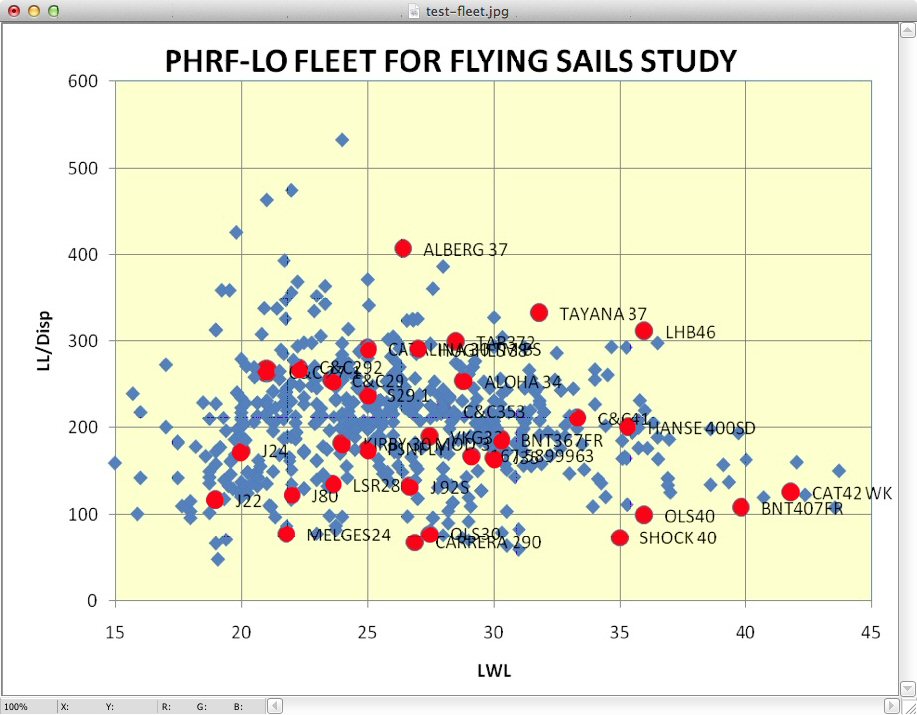
It has undertaken a project in conjunction with US Sailing's Offshore Office under Jim Teeters, Associate Offshore Director. Jim has worked on a database of LO boats using their Velocity Prediction Program (VPP).
Ready for the 2012 season will be a calculated delta for the No Flying Sails (NFS) base handicap, modifications to the Genoa size, and propeller type adjustment tables all based on VPP analysis.
All changes will be reviewed by Central Council and of course the principle of performance handicapping is still very much in the forefront. More details will be released at the PHRF-LO Annual General Meeting and also the Spring training session.
NFS-Delta
About 10 years ago, the Speed Potential (handicap) for No Flying Sail (NFS) boats was decoupled from that of the Flying Sail (FS) handicap. This increased the work-load of Central Council and has also resulted in a tendency for the two handicaps to move together.
The current project is aimed at fixing many of the issues in the NFS handicaps and to rationalize the difference between the FS and NFS handicaps (Delta).
This new Delta is solely based upon Velocity Prediction Program (VPP) analysis of optimum boat performance both with and without flying sails. In other words, a boat’s best performance downwind with a spinnaker compared to its best performance with only genoa and mainsail.
Genoas
Genoa size adjustment was also studied using the same database and the VPP.
This has resulted in new values in the genoa size adjustment table. These changes are more in the nature of a smoothing rather than major changes although the small jibs do get significantly bigger allowances.
At the same time we have started to drop the 3 sec increment for individual adjustment and in future adjustments will be rounded to the nearest whole number. The total adjustment and ASP will therefore not be an increment of 3.
Propulsion
It has long been felt that the current allowance for fixed blade props is not adequate to cover the lost performance due to drag. In order to improve fairness for cruising boats a range of boats sizes has been analyzed to determine the drag due to fixed 2 blade and 3 blade props.
The resulting changes to the adjustment table are not large enough to cause skippers to move from folding to fixed but at least will create a more level field for the cruiser racer fleet.
In Conclusion
Rest assured that Central Council, in the light of performance data, will scrutinize the application of these adjustments and the NFS Delta. Expect to see changes in both the FS and NFS handicaps for 2012.
This whole project, which will have taken nearly two years to complete, is part of a general movement to improve the objectivity within the PHRF-LO handicapping system. VPP is a very powerful tool and it is teaching us a lot.
You may expect more developments as we discover soft spots in the system.
- Details
- Category: Central Council
Answers to questions at the Training Session:
1. A database of Lake Ontario classes was set up choosing boats that spanned the range of classes we have on the lake.
All these classes had been measured for ORR. The primary analysis was done on this database and the ORR VPP was done for each boat class both with and without spinnakers.
The difference in performance being referred to as the NFS-Delta.
The next step was to develop a predictive algorithm that would provide an estimate of those deltas using the existing measurements that we have on all Lake Ontario Classes.
This means that 95% of all the estimate will be within 3 secs per mile.
Sorry for the long answer, the short answer is that we are using the existing measurements in our database.
2. Firstly, PHRF-LO cannot accommodate all the different courses that might be run but it so happens that the course type we have chosen to use in our algorithm is referred to as a general purpose course.
This represents courses which finish were they start and entail reaching as well as windward leeward.
In fact, it could not be better for your type of course. Ultimately, clubs can always make their own handicap adjustments to suit their local situation and conditions.
3. The "Standard Error" or SD of the error I referred to is the error between the VPP observed delta and the delta from the estimating algorithm for the same classes.
You appreciate that we cannot perform an ORR VPP calculation on all our classes but only on our representative database. We then have to estimate the delta based on the dimensional specifications we have.
Your second sentence is correct except that the GPH (General Purpose Handicap) is based on 8 kts.
- Details
- Category: Central Council
Due to ongoing confusion regarding the necessity to measure the Headsail Half Width (HHW), Central Council has again reviewed he wording and voted to approve a rewording which they hope will clear up any misunderstandings.